Jewelry Me*
Online jewelry store

About the client
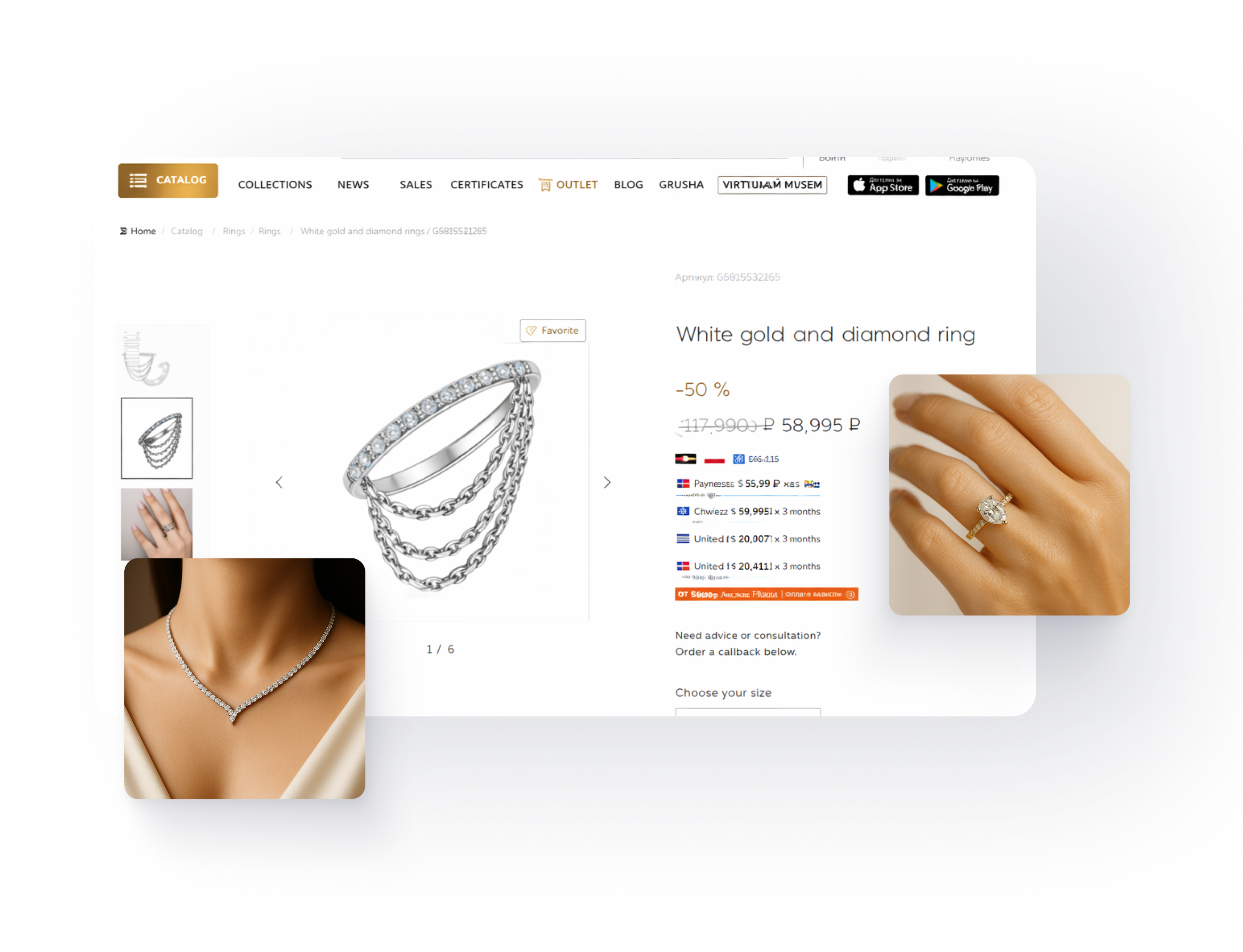
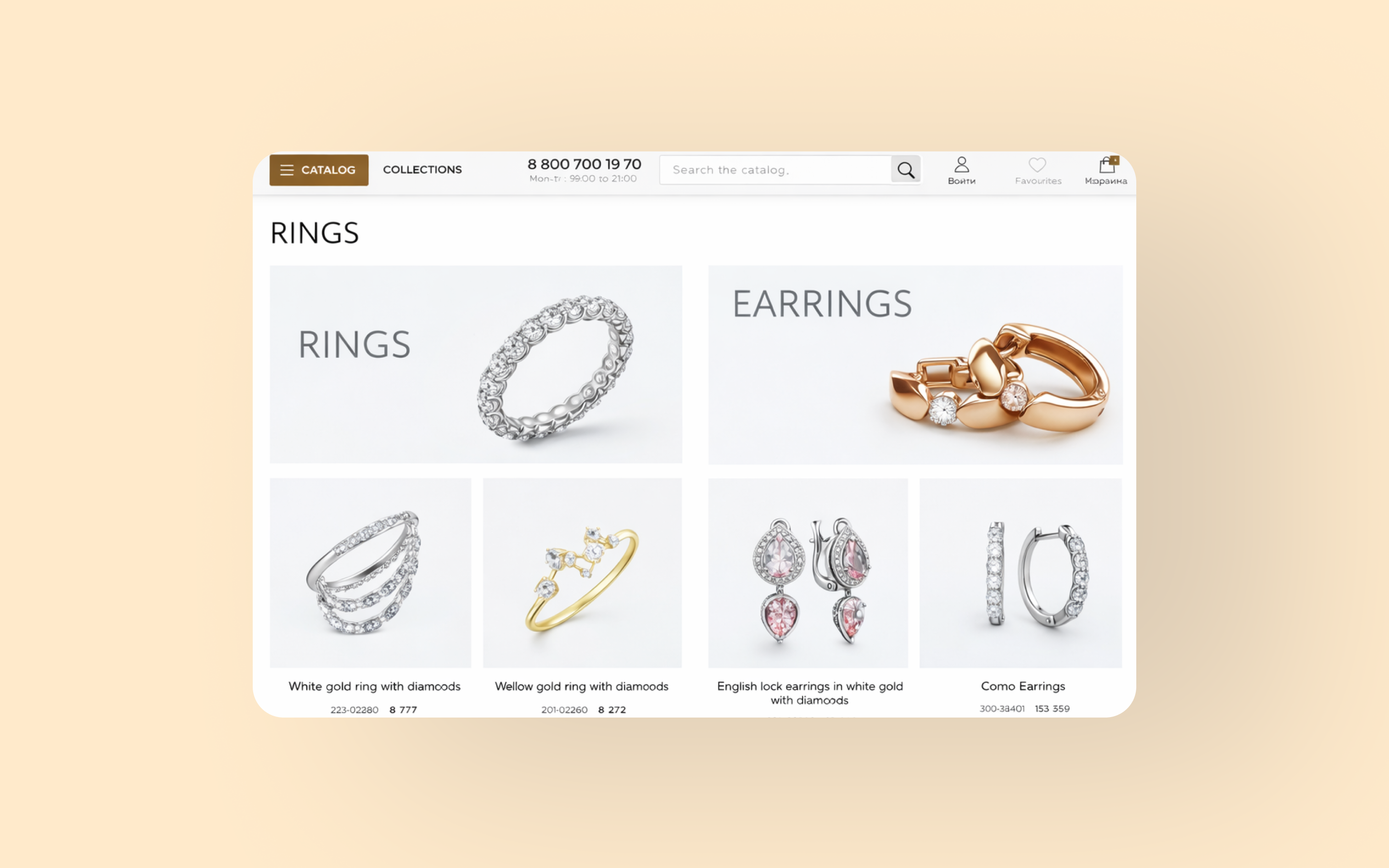
Jewelry Me* is one of Russia's most popular jewelry houses. They have both boutiques and an online store with a wide range of jewelry for every taste.
The brand's mission is to create highest quality jewelry at affordable prices. Hundreds of orders are placed daily: people delight loved ones with gifts, treat themselves, and propose with Jewelry Me* rings.


Task
Despite high popularity and stable order flow, the Jewelry Me* online store faced technical issues that hindered growth and worsened user experience. The client approached us with the task: eliminate critical errors, automate processes, and synchronize all sales channels—from website to mobile app and warehouse system.
Client's problems
Order loss at checkout stage
The client regularly had problems with order processing: some requests didn't reach CRM due to integration errors and template bugs. Users filled carts but didn't complete purchases—orders "disappeared" or saved with distorted data. This reduced conversion, directly impacted revenue, and caused customer dissatisfaction.
At project start, saved carts were 2.5 times lower than a year after implementing solutions—most potential orders were lost at the most critical stage.
Incorrect product card display
Product data (specifications, photos, availability) was updated manually. This led to cards containing outdated or conflicting information: missing important attributes (weight, inserts, hallmark), images not loading, and stock not matching reality.
Up to 30% time spent on 1C exports and catalog updates
Stock updates between 1C, website, and app were done manually. Managers spent hours updating information. With high order volumes, this became a critical risk point—possible double sales and customer conflicts due to unavailable items.
Disconnected data between website and app
Users experienced confusion: for example, bonuses earned in the app might not display on the website. Also, order statuses weren't synchronized—customers didn't understand their order stage. This harmed user experience and caused support requests.
High cybersecurity risks
The platform powering the online store hadn't been updated: core and modules were outdated, didn't support new features, scaled poorly, and created security risks. Meanwhile, stopping the site for updates was impossible—active sales continued.
Solution
Bug fixes and store stabilization
We started with thorough audit of the online store's current state. Studied error logs, bugs affecting order processing and card display correctness. Discovered weak points in checkout logic causing data loss or incorrect transmission. Rewrote these code sections and tested the "cart — checkout — CRM" chain across different scenarios.
Automation of 1C exchange and catalog updates
Previously, product data (specifications, images, stock) was manually entered into Bitrix from 1C. We developed a module linking 1C and the website, enabling two-way synchronization. Now all changes in 1C automatically reflect in product cards. Same for stock: eliminated manual work and minimized error risk.
Website and mobile app synchronization
Discrepancies existed between two platforms in bonus display, order statuses, product availability. We rebuilt data exchange logic: implemented unified API, centralized data storage, and real-time synchronization. This allowed customers seamless switching between platforms without losing progress.
Bitrix update and scaling preparation
Platform update was conducted gradually. We migrated the project to a secure test environment, checked all core and module updates for compatibility. Then deployed changes to production without site downtime or interference with current sales. This prepared the store for further growth.
Result
All critical bugs eliminated—order processing works stably without losses or errors.
Automated card and stock updates saved team up to 70% time.
Complete website and mobile app synchronization—order statuses, bonuses, and products display identically.
Updated Bitrix core and modules—performance increased, foundation for scaling established.
Support requests reduced 5 times—users encounter fewer errors after implementing our solution.
Number of orders doubled after implementing solutions.
Average order value tripled due to increased order volume and streamlined service operation.

* project is under NDA, so the real name is replaced